ADubhlaoich
Improving my Jobseeker's holiday journey
July 12, 2026In early February 2026 I stopped working for F5. I immediately went on Jobseeker's Pay-Related Benefit, which is a relatively new social welfare payment that is based on your PRSI contributions.
A few months later, I decided to travel to the Rosorcas Festival of Circus Arts in Granlahan. In order to do some research for the festival, I decided to travel a few days early. This required me to indicate to the Department of Social Welfare that I would be on holiday.
Outside of catching up with friends, conducting user research during the festival was my secondary motivation for attending, and I didn't anticipate that indicating I'd be away from Dublin a few days would become an opportunity for some service design practice.
Going online and getting shocked
My first exposure to the Department of Social Welfare was as a teenager, applying for the Back to Education Allowance. Back then, everything was on paper. To apply for a specific scheme, you needed to visit an Intreo office to pick up a physical form.
Nowadays, you can apply for many different schemes through the MyWelfare website, which has a centralised login system for multiple online government services.
For convenience, I decided to file my holiday online. Within a few days, I got a notification about getting a notification (This sounds nonsensical, but will make more sense later) and logged into the website to see the following card at the top of the page:
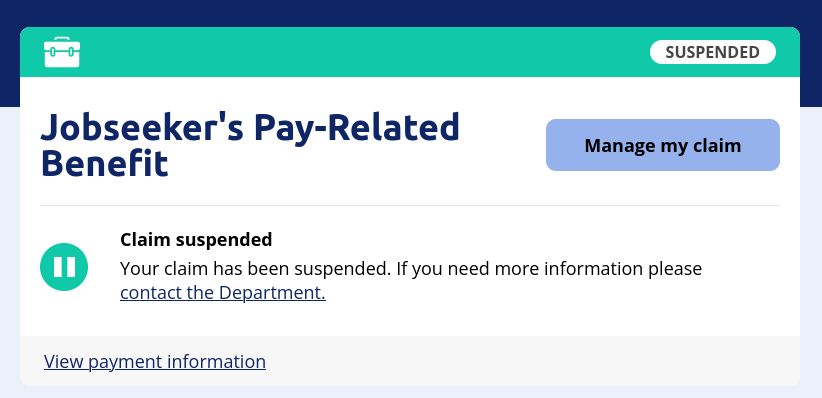
I was pretty shocked and immediately went to the closest Intreo office to investigate.
For me, the term suspended has a punitive quality to it. By definition, I am suspending a water bottle by raising it to my face, but I don't know how specific words are defined within different bureacracies. My gut instinct was that I might have done something wrong.
Speaking to someone in person, they assured me that I did not do anything wrong, and that the payment was essentially paused, and that once I returned to the office, I could unsuspend the payment. I later discovered that since I filed the request online, it would automatically be unsuspended based on my indicated return date, and would not need to visit an office in person.
Literacy and ambiguity
Years ago I read a report about the UK's websites relating to social welfare having much more technical jargon than other government websites. At the time, I hoped that was an accident, and this experience brought me back to a train of thought from that report.
This lead me to a page published by NALA (National Adult Literacy Agency) on Literacy and Numeracy in Ireland, which has this opening paragraph (Emphasis mine):
The Organisation for Economic Co-operation and Development (OECD) Adult Skills Survey 2023 shows that about 1 in 5, adults aged 16 to 65 in Ireland are at or below Level 1 on a five-level literacy scale (21%). At this level a person may be unable to understand basic written information.
I think that if someone is struggling to read, they probably also struggled in school. And school is where a lot of us probably heard the term suspend most frequently in the context of suspension as a penalty for misbehaviour of some kind.
If someone has already struggled in school, what are the chances they will need government support in the future? How will they react to reading that their support has been "suspended" as a result?
From talking to friends who work in the civil service, I'm under the impression that suspend has a specific internal or legal definition, but for a better user experience, the phrasing of content should reflect the language of the people using the website.
This is how I would have designed the card instead:
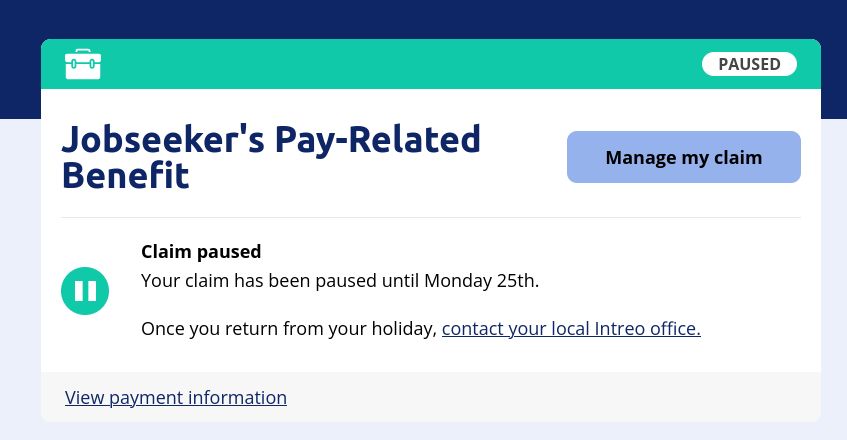
This design is slightly redundant, as it instructs you contact your local Intreo office once you've returned. The first civil servant I spoke to stated this would be necessary, while the second told me I would not.
If people working in the office have different and contradictory opinions on the user flow, the people using the service will have even less confidence that they're making the right decisions.
Uncertainty causes distress, distress requires reassurance, and perhaps more people are visiting offices for appointments than they might otherwise if things were less ambiguous.
Additional redunancies
Earlier in this piece I mentioned getting a notification about a notification. When I asked myself how I would rephrase the main card about the Jobseeker's status, I realised there were a few other places that could be improved too:
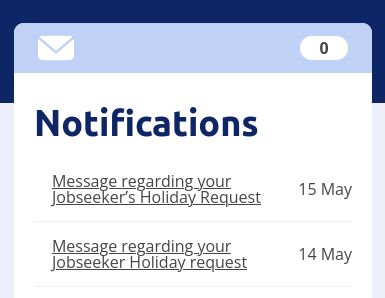
On the landing page of the website, right of the main card, is this sidebar with items listed as "Message regarding your Jobseeker's Holiday Request".
If you click any of those items (Which are links), it brings you to the notification page:
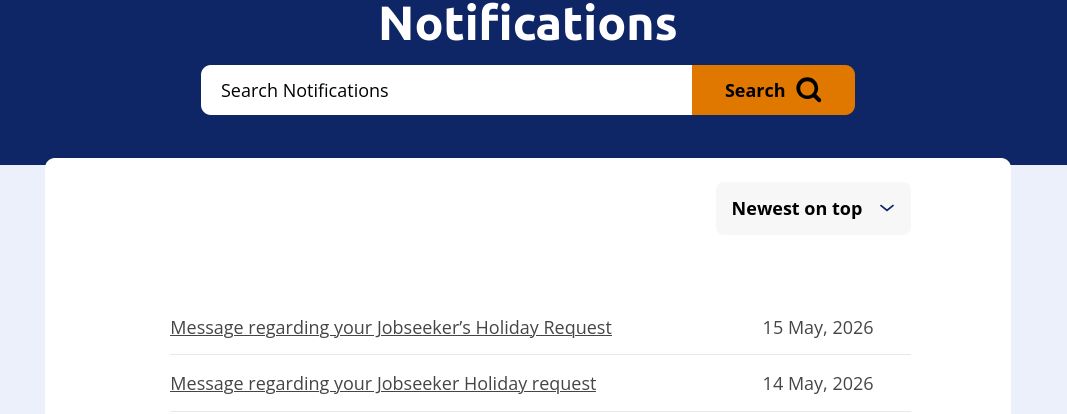
The text is consistent, which is expected, but offers very little context. You might hope that opening the notification would give more information:
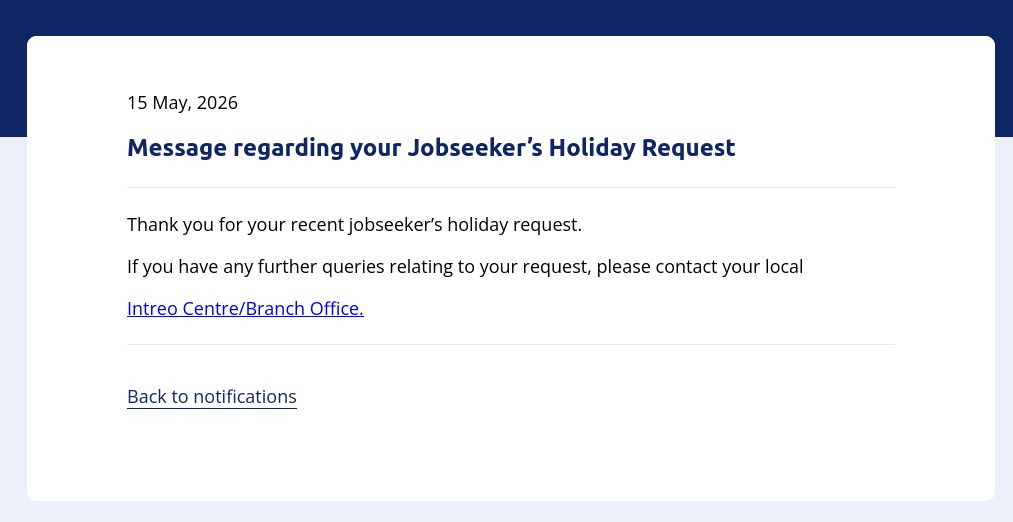
You would be mistaken. All information about your status is contained in the main page, and the extra space afforded by notifications being given their own message screen is not used in a useful way.
The initial notifications could instead be rewritten as so:
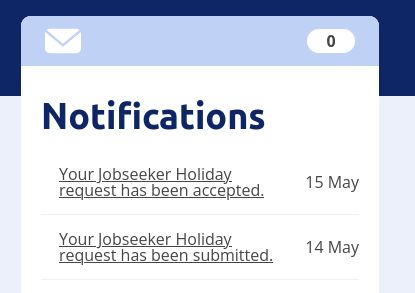
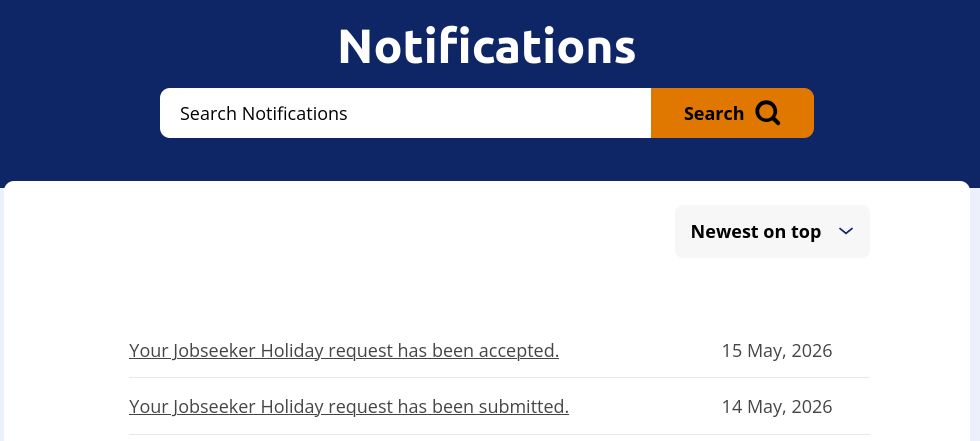
At a glance, this immediately gives the user an impression of what the notification is about, and what the state of their request is. Without even investigating the full message, they already know whether or not their request has been accepted or not.
As for the message itself:
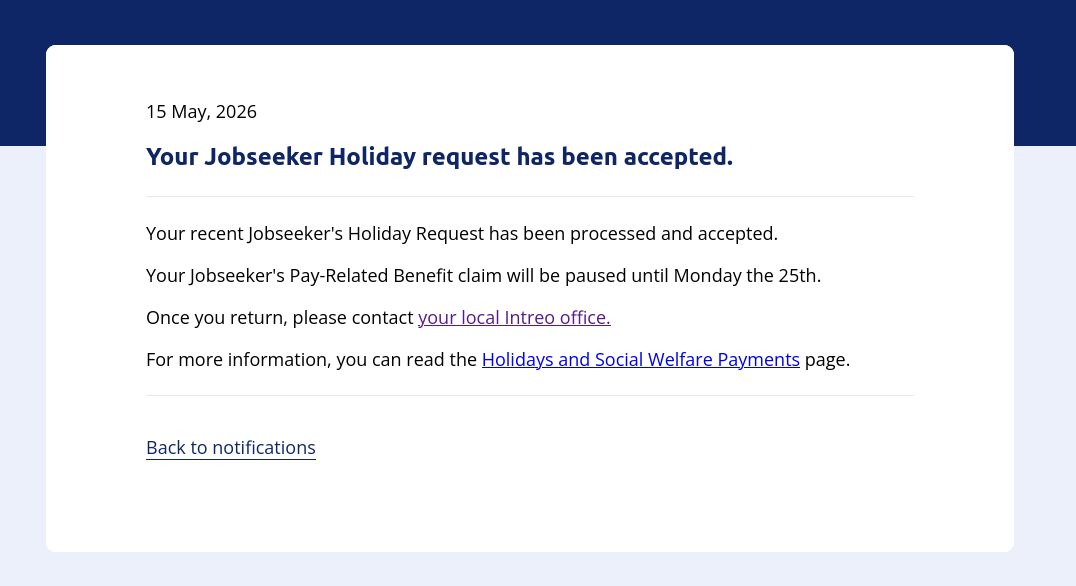
The new version of the text reinforces what the user will have read on the landing page, and even offers useful links at the bottom of the message to the local Intreo office and "Holidays and Social Welfare Payments" pages. Not as concise, but much clearer.
Never sacrifice efficacy for efficiency when communicating information.