ADubhlaoich
Creating a new code of conduct
July 30, 2026In February 2024, Pobail Stomp was forced to stop running a social dance. We stopped running events altogether a while, but have since continued to run some version of Emerald Swing.
Right now, our game plan is to run one event per quarter of the calendar year: Emerald Swing in February, and a Swing go Tapaidh in June, September and November.
As part of iterative improvements on our events, one of the things we decided to take a look at is our code of conduct. I've written about why you should adopt a code of conduct and earlier than that the anatomy of a code of conduct: overall, I consider the code of conduct successful.
Almost everyone in Dublin that runs events related to swing dancing has adopted it, and awareness of it lead to many critical conversations and a handful of necessary interventions. However, in the years since first adapting it, I've become a much more proficient writer.
I've since noticed three specific issues with how the existing code of conduct is structured:
- It covers both the core code of conduct text as well as procedural guidelines
- It doesn't clearly separate physical safety and social etiquette expectations
- There's a few things that it doesn't cover at all
The first issue about the code of conduct text and procedural guidelines means that it's unnecessarily long, and that makes it more likely for someone to skim it, if not read it at all. The procedural information is important and should be accessible, but it should be part of a larger set of safety guidelines, and not part of the core text.
The second issue about not clearly separating physical safety and social etiquette expectations means that the focus of the text sometimes bounces from one tone to another.
Finally, the things it doesn't cover at all include harassment off the dancefloor, and personal hygiene. Both examples are somewhat tricky to handle for different reasons.
"Off the dancefloor" harassment is difficult to define, but needs to cover using social media as a way to stalk people, while "personal hygiene" is largely about reminding people that their clothing and deodorant choices affect anyone they're in proximity to.
Restructuring the code of conduct
The code of conduct is a standalone document. This means it needs to make contextual sense without relying on anything else.
It can, however, be contained as part of a larger set of safety guidelines. This allows us to separate procedural information from the code itself, which some organisations already have.
When we printed the code of conduct, we printed every localisation we had, and laminated it. Three copies were made, so that each organisation could have one at their check-in desks during events.
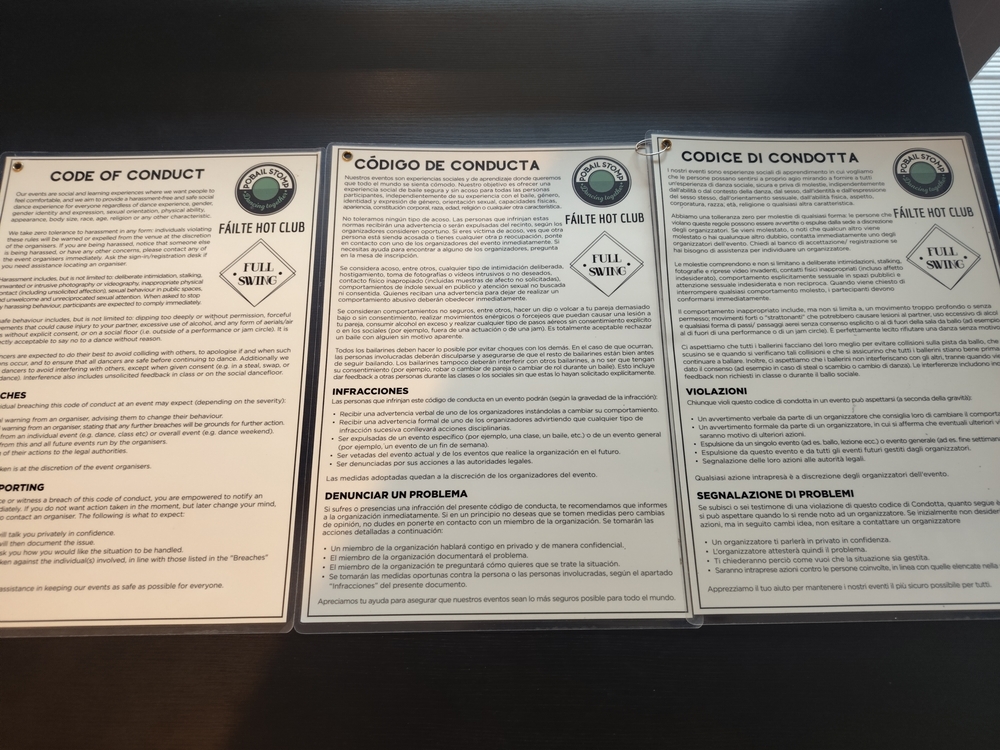
For redundancy or conciseness, other organisations have reprinted the code of conduct without the "Breaches" and "Issue Reporting" sections, which are the procedural information not necessary for the core text.
Adopting the code of conduct also implicitly imposes these specific procedures on the organisation. In Pobail Stomp, we refer to everyone in the core group as an organiser, while I (And occasionally others) specifically act as the coordinator.
With this mental model, any of us is empowered to tackle a conduct issue. This approach works because of our structure, and the familiarity we have within the community.
If your organisation has more of a vertical hierarchy, it makes less sense - especially if it means a new community member checking wristbands or DJing is suddenly responsible for safeguarding.
It works for Pobail Stomp in practice, and one thing we publicise for Emerald Swing that is not represented in the text is that we have a safety officer separate to the core group. This way, we as organisers are also accountable.
With all of this context in mind, here's a simple but major change for the new code of conduct:
The code of conduct should mention the inclusion of a safety officer, and procedural information should be part of broader safety guidelines.
This reduces the amount of text to read, which has a side benefit of making it easier to localise the text. Currently, English, Spanish and Italian are represented localisations. Turkish makes sense demographically, while Irish is important in principle.
A second way to reduce the amount of text to read is to change the content from being primarily paragraph-based to list-based. This makes it easier to scan (Improving the chances someone will read it), as well as making it simpler to reference using a numbered list, with a single item per topic.
If a specific item needs to be discussed, you can refer them to "Guideline X" instead of stating "The bit about floorcraft that doesn't use the word floorcraft is at the start of paragraph five". Separating the different kinds of topics covered by the code into its own line also makes designing each sentence for maximum comprehension easier.
This gives us our second major change in the layout of the code of conduct:
Each specific guideline of the code of conduct should be given its own line as part of an enumerated list.
Rewriting the text
When writing, the first fundamental question you have to answer is "What do I have to explain?". In the context of writing fiction, this often begins with situating the character perspective: who they are and what world they live in.
For instructional content (Such as beloved documentation), this involves research to figure out what level of expertise the reader will have, so that you can focus on critically important detail.
Even without context, most writers can edit about a third of most text away on a first draft. We strive to omit needless words: the opening paragraph names a large amount of characteristics to be inclusive but doesn't actually use the word inclusive at any point.
It also vaguely describes events as "learning experiences", which although technically correct, isn't actually the focus. The existence of dance classes is largely a necessity because most of us get into dancing as adults. It's not something we grew up with as part of our homes or larger community.
Better to drop it altogether.
Much like the opening paragraph's broad attempt to describe characteristics for inclusivity, there is an equally broad attempt to define harrassment. It's simpler to trust the term: if clarification is required, a procedural intervention is probably already happening.
With the structural changes in mind, almost all of the changes have been defined. There's some atomic items to address, whose highlights include:
- Referring to the items of the code of conduct as "rules", so there is no ambiguity when referring to the safety documentation as a whole
- Including social media in the harassment rule to account for someone using "offsite" mediums like WhatsApp groups as an attack vector to stalk people
- Simplifying rules for aerials and (physically) unsafe behaviour
- Ordering the rules in a way that logically groups similar kinds of issues
The first working draft
After a few rounds of feedback from people, this is our new code of conduct.
It will hopefully never be put to the test.
Once we've worked out the new procedures for the safety guidelines, we can pair them with our existing refund policy and fill in known gaps for a thorough and complete set of terms and conditions.